
Permit Exam Day: A Calm, Practical Checklist
The night before and the morning of your exam shouldn't feel chaotic. Use this calm, practical checklist to walk in ready.
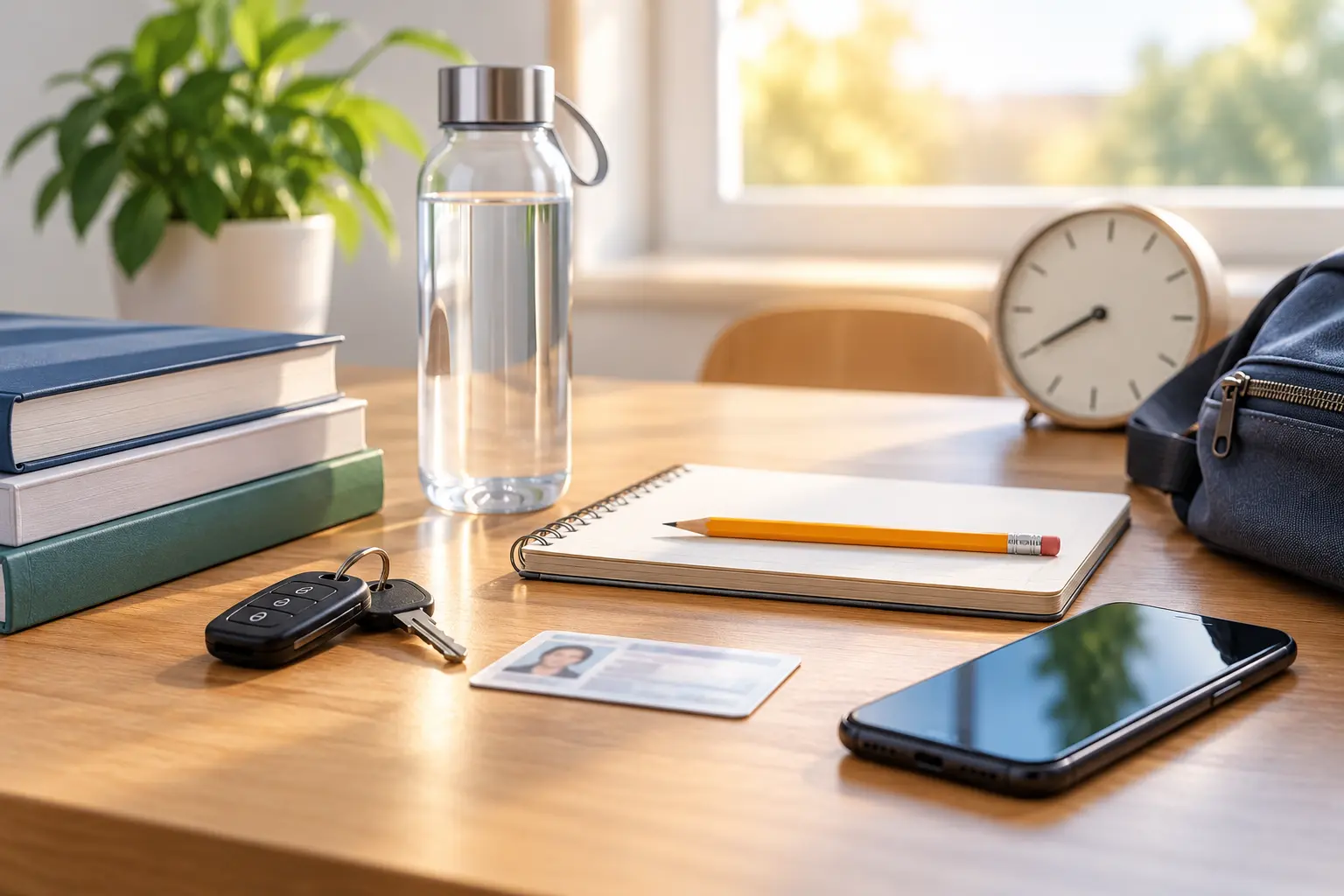
To be ready for your permit exam, bring a valid photo ID, proof of your Social Security number, proof of residency (if required by your state), any required parental consent or enrollment paperwork if you're a minor, and payment for the testing fee — then arrive 15–30 minutes early. Most exam-day stress isn't about the test content at all; it's about last-minute scrambling over paperwork or timing. This checklist removes that variable so the only thing left to think about is the questions themselves.
The Night Before
You cannot out-study the night before what months of preparation should have covered — and trying to usually backfires, replacing confidence with anxiety. Instead:
Do one final, short review — not a marathon session. A 20–30 minute review of your weakest topics is enough. If you've been using a diagnostic-based course, this is where knowing your specific gaps pays off: you review those, not everything.
Lay out your documents. Don't leave this for the morning. Put your ID, paperwork, and payment method in one place by the door.
Confirm your appointment and location. DMV/permit testing locations and hours vary; a quick double-check avoids a wasted trip.
Set an alarm that gets you there early, not on time. Parking, check-in, and paperwork processing all take longer than expected.
Sleep. Fatigue affects recall and reading comprehension more than most learners expect — a rested brain outperforms a crammed one.
What to Bring: The Core Checklist
Item | Why You Need It |
|---|---|
Valid government-issued photo ID | Required to verify your identity before testing |
Proof of Social Security number | Required in most states for a learner's permit application |
Proof of residency (utility bill, lease, etc.) | Required in many states if your ID doesn't show a current address |
Parental/guardian consent form (if a minor) | Required in most states for applicants under 18 |
Proof of enrollment or completion (driver's ed certificate, if applicable) | Some states require this before permit testing |
Payment for testing/licensing fees | Fees vary by state; check accepted payment methods in advance |
Glasses or contacts, if you need them for the required vision screening | Most states include a basic vision test as part of the permit process |
Exact requirements vary by state and can change, so confirm the current list on your state DMV's website a few days before your appointment — don't rely on memory or what a friend needed last year.
Morning-Of: Step by Step
Eat something. A blank stomach and a blank mind aren't a good combination for 30–50 multiple-choice questions.
Arrive 15–30 minutes early. This buffers against lines, parking, and paperwork processing time.
Do a 5-minute mental warm-up, not a cram session. Skim your weak-topic notes once. Don't open a fresh study session you haven't seen before — new material this close to test time adds noise, not confidence.
Read each question fully before answering. Permit exam questions are often designed with one word that changes the correct answer (e.g., "must" vs. "may," "always" vs. "in most cases"). Rushing is the single most common way learners miss questions they actually knew.
Answer what you know first, flag the rest. If your test allows moving between questions, don't get stuck. Answer confidently, flag uncertain ones, and return to them with a clear head.
Common Exam-Day Mistakes to Avoid
Showing up without proof of residency because "my ID has my address on it" — many states still require a separate document.
Assuming your appointment guarantees a specific time slot — some testing locations operate first-come, first-served within a window.
Cramming new material in the waiting room — this raises anxiety more than it raises your score this close to the exam.
Skipping breakfast because of nerves — low blood sugar affects concentration during a 30–50 question test.
Frequently Asked Questions
What happens if I forget a required document?
Most testing locations will not administer the exam without required documentation, and you'll need to reschedule. Confirm your state's exact document list a few days beforehand to avoid this.
How early should I arrive for a permit exam?
15–30 minutes early is generally enough to handle check-in and paperwork without feeling rushed. Locations with longer lines may warrant arriving even earlier — check your local office's typical wait times if available.
Should I study the morning of the test?
A brief review of your known weak topics is fine. Avoid studying entirely new material the morning of — at that point it adds stress without meaningfully improving your score.
Is there a vision test as part of the permit exam?
Most states include a basic vision screening as part of the permit application process. Bring glasses or contacts if you need them for daily vision correction.
Not sure which topics still need work before test day? Take the free X-Ray diagnostic to find your weak spots first, then review with purpose instead of guessing.